
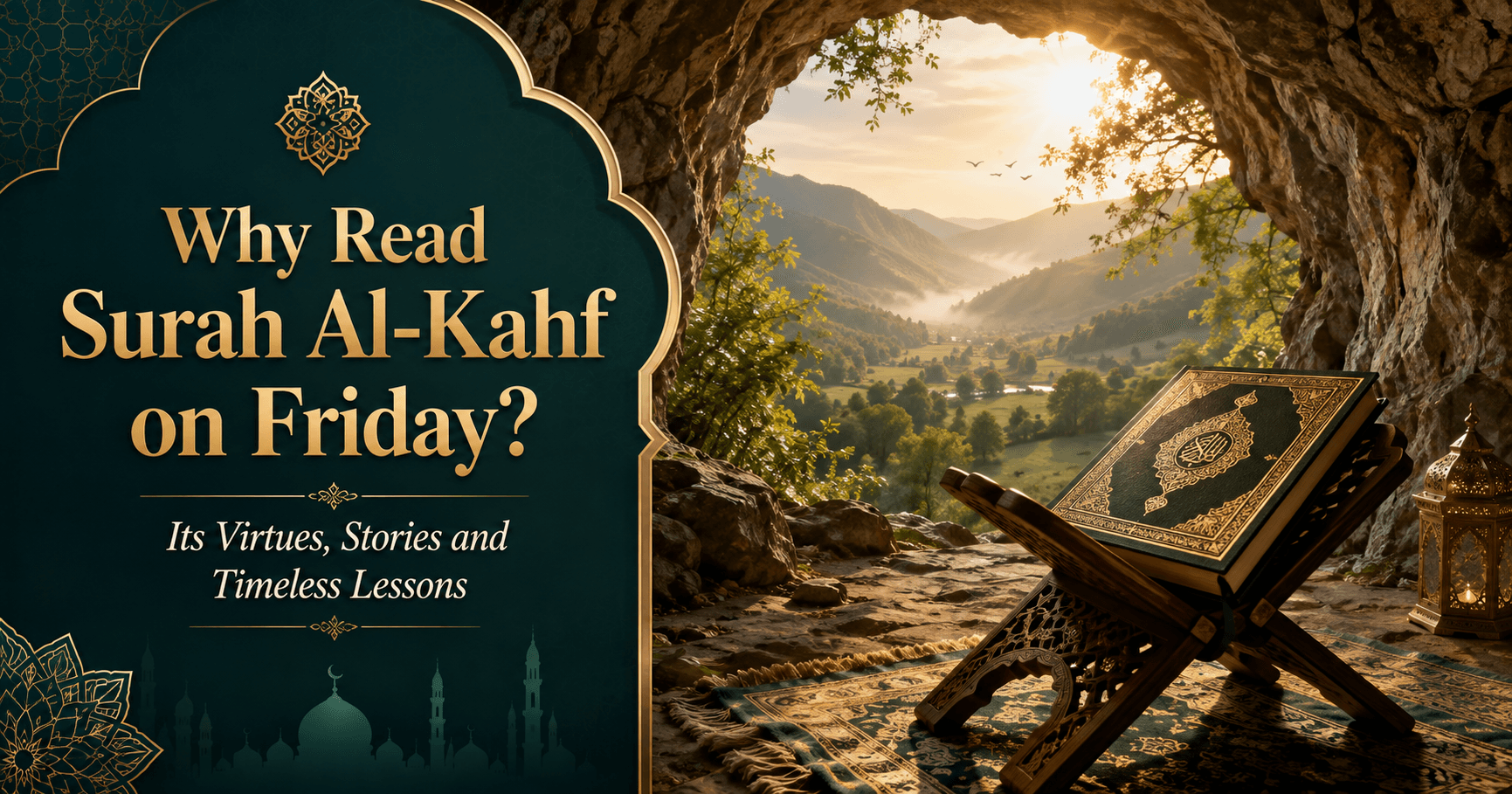
Why Read Surah Al-Kahf on Friday? Virtues and Lessons
Learn why Muslims read Surah Al-Kahf on Friday, what the authentic reports say about its virtue, and the major lessons found throughout Surah 18.
- Written by
- Zain Qalandar Shah
- Islamic reviewer
- Islamic scholarly review pending
- Last reviewed: Not yet reviewed
- Last content update
- Reading time
- 12 min read
First published
Surah Al-Kahf is the 18th chapter of the Quran and contains 110 verses. Many Muslims make time to recite it on Friday because a reported narration connects its Friday recitation with light lasting until the following Friday.
However, Surah Al-Kahf should not become only another item on a weekly checklist.
Its stories explore what happens when faith is placed under pressure, wealth creates pride, knowledge reveals human limitations, and power is placed in someone's hands. Reading the surah regularly gives a believer repeated opportunities to reflect on these tests.
This guide explains the reported Friday virtue, the surah's major themes and the separate authentic narration concerning protection from the Dajjal.
Why do Muslims read Surah Al-Kahf on Friday?
A report from Abu Sa'id states that a person who recites Surah Al-Kahf on Friday will have light until the following Friday.
The report is recorded in Mishkat al-Masabih 2175, which attributes its transmission to al-Bayhaqi in al-Da'awat al-Kabir. The source page displays the grading Hasan by al-Albani.
Hadith reference
Light between two Fridays
Whoever recites Surah Al-Kahf on Friday will have light until the following Friday.
Verification note: The source attributes this report to al-Bayhaqi and displays the stated grade. It should not be attributed to Sahih al-Bukhari or Sahih Muslim.
This narration is the main evidence commonly cited for reading Surah Al-Kahf on Friday.
The report uses the language of light. This article does not attempt to measure that light physically or turn it into a guaranteed worldly outcome. The wording should be preserved respectfully, while detailed explanations are left to qualified scholars.
Is the Friday narration found in Sahih al-Bukhari or Sahih Muslim?
No.
The report about light between two Fridays is not found in Sahih al-Bukhari or Sahih Muslim under that wording.
It is therefore inaccurate to publish a social-media post or article that says:
“Sahih al-Bukhari says whoever reads Surah Al-Kahf on Friday receives light until the next Friday.”
A responsible article should name the collection in which the report is being cited and display its available grading clearly.
Sahih al-Bukhari and Sahih Muslim do contain other authentic reports connected with Surah Al-Kahf, but those reports describe different virtues or instructions.
Surah Al-Kahf is more than a weekly recitation
Reading the Arabic text carries the virtue mentioned in the Friday report. At the same time, understanding the surah helps its warnings and lessons influence daily life.
The chapter contains several major narratives:
- The young believers who sought refuge in the cave
- The owner of two gardens
- Musa and a servant whom Allah had given knowledge
- Dhul-Qarnayn and the responsible use of power
Each account presents a different type of test.
Together, they encourage faith, humility, gratitude, patience and responsible action.
The young believers in the cave
Verses 9–26 describe young believers who faced a serious test of faith.
Rather than abandoning their belief under pressure, they withdrew to the cave and asked Allah for mercy and right guidance.
إِذۡ أَوَى ٱلۡفِتۡيَةُ إِلَى ٱلۡكَهۡفِ فَقَالُواْ رَبَّنَآ ءَاتِنَا مِن لَّدُنكَ رَحۡمَةٗ وَهَيِّئۡ لَنَا مِنۡ أَمۡرِنَا رَشَدٗا
Urdu translation · Fatah Muhammad Jalandhari
جب وہ جوان غار میں جا رہے تو کہنے لگے کہ اے ہمارے پروردگار ہم پر اپنے ہاں سے رحمت نازل فرما۔ اور ہمارے کام درستی کے سامان مہیا کر
English translation · Marmaduke Pickthall
When the young men fled for refuge to the Cave and said: Our Lord! Give us mercy from Thy presence, and shape for us right conduct in our plight.
Their story teaches that reliance upon Allah is not passive.
The young believers made a difficult choice, moved away from danger and then placed their trust in Allah. Their dua asks not only for protection, but also for guidance in handling their situation correctly.
The Quran does not make the modern location of the cave or the names of the young men central to the lesson. A reader benefits more by focusing on their faith, courage and dependence upon Allah.
The owner of the two gardens
Verses 32–44 describe a man who was given valuable gardens, crops and wealth.
Instead of recognising those blessings as gifts from Allah, he became confident that his prosperity would remain. His wealth encouraged pride and weakened his awareness of accountability.
The account reminds readers that:
- Wealth is temporary
- Visible success is not proof of Allah's permanent approval
- Gratitude protects the heart from arrogance
- Material strength cannot prevent Allah's decree
- A believer should recognise dependence upon Allah
This story remains relevant in a world where wealth, followers, possessions and public status can easily become measures of personal worth.
The problem is not having wealth. The danger begins when wealth causes a person to forget the One who provided it.
Musa and the limits of human knowledge
Verses 60–82 describe Musa travelling to learn from a servant whom Allah had given special knowledge.
During the journey, Musa sees actions that appear confusing or troubling. Their wisdom is explained only later.
The passage teaches intellectual humility.
Human beings often judge events according to the limited information available to them. Allah's knowledge is complete, while human understanding remains partial.
This does not mean that ordinary people may commit wrongdoing and defend themselves by claiming secret knowledge. The narrative describes a specific situation revealed in the Quran.
Its lesson for the reader is humility, patience and caution when assuming that one's first interpretation contains the entire truth.
Dhul-Qarnayn and responsible power
Verses 83–98 describe Dhul-Qarnayn as a person who travelled widely and was given significant authority and resources.
He did not treat power as proof of personal superiority. He used effort, organisation and available means to help people facing danger.
After completing the barrier, he attributed the success to Allah's mercy rather than presenting it as his own independent achievement.
The account teaches that:
- Power is a responsibility
- Leadership should serve people
- Strong plans still depend upon Allah
- Success should produce gratitude rather than pride
- Human achievements remain temporary
Authority is tested not only by what a leader can do, but by how responsibly that ability is used.
A surah about four recurring tests
Readers often study the major narratives of Surah Al-Kahf as examples of four broad tests:
- The test of faith — the young believers in the cave
- The test of wealth — the owner of the gardens
- The test of knowledge — Musa's learning journey
- The test of power — Dhul-Qarnayn
This is a helpful study framework rather than a verse or hadith quotation.
These tests continue to appear in different forms throughout human life. A person may face social pressure because of faith, become distracted by wealth, grow proud of limited knowledge or misuse authority.
Weekly engagement with Surah Al-Kahf can remind a believer to examine how they are responding to these challenges.
Surah Al-Kahf and tranquility
Sahih al-Bukhari records that a man was reciting Surah Al-Kahf when a cloud approached and his horse became unsettled.
When he told the Prophet ﷺ what had happened, the Prophet explained that it was sakinah—tranquility—that had descended because of the recitation of the Quran.
Hadith reference
Tranquility during the recitation of Surah Al-Kahf
The Prophet explained that the tranquility which descended was connected with the recitation of the Quran.
Verification note: The narration describes a particular event during the recitation of Surah Al-Kahf. It should not be rewritten as a guarantee that every reader will experience an identical visible event.
This narration is authentic, but it is separate from the report about Friday recitation and light between two Fridays.
Each narration should be presented according to its own wording rather than combining them into a new promise.
Protection from the Dajjal
Another authentic narration concerning Surah Al-Kahf is found in Sahih Muslim.
It states that whoever memorises the first ten verses of Surah Al-Kahf will be protected from the Dajjal.
Hadith reference
The first ten verses and protection from the Dajjal
Whoever memorises the first ten verses of Surah Al-Kahf will be protected from the Dajjal.
Verification note: This narration specifically mentions memorising the first ten verses. It is distinct from the report concerning Friday recitation.
The narration gives a specific instruction: memorising the first ten verses.
It should not be rewritten as:
- Reading the complete surah once automatically fulfils the memorisation instruction
- Listening passively carries exactly the same stated promise
- Reading any ten verses produces the same result
- Friday recitation and Dajjal protection are a single narration
These virtues may both concern the same surah, but they come from separate reports with different wording.
What about the last ten verses?
Sahih Muslim 809b records a variation in transmission.
One narrator mentioned the end of Surah Al-Kahf, while another mentioned its beginning.
Because such transmission details require careful scholarly treatment, readers should avoid confidently combining every wording into a new formula.
A person may memorise the first ten verses based directly on Sahih Muslim 809a. Questions about the different narrations and their detailed interpretation can be discussed with a qualified scholar.
A practical Friday Surah Al-Kahf routine
Surah Al-Kahf contains 110 verses. Some readers can comfortably complete it in one sitting, while others may find it easier to divide the surah into smaller sections.
The following is a practical reading plan, not a fixed religious ritual.
Option 1: Read it in one sitting
Choose a quiet part of Friday and read the complete surah at a measured pace.
Avoid rushing simply to mark the task as complete.
Option 2: Divide it into sections
You may divide the surah into several reading sessions, for example:
- Verses 1–31
- Verses 32–59
- Verses 60–82
- Verses 83–110
This makes the surah easier to complete while preserving attention.
Option 3: Combine recitation with understanding
After reading each major section, read a trusted translation.
Focus on one main question:
- How did the young believers protect their faith?
- What caused the owner of the gardens to become arrogant?
- What did Musa learn about the limits of human knowledge?
- How did Dhul-Qarnayn use authority responsibly?
Option 4: Begin memorising the first ten verses
Memorise one or two verses at a time with the help of a qualified Quran teacher.
Review previously memorised verses before adding new ones. Accuracy and consistency are more important than speed.
Does listening replace reciting Surah Al-Kahf?
Listening to Surah Al-Kahf can support pronunciation, reflection and familiarity with the verses.
However, the Friday report cited in this article specifically speaks about reciting Surah Al-Kahf.
For that reason, this guide does not claim that passive listening carries the identical narrated virtue.
A person who is learning may listen while following the Arabic text and then recite according to their ability.
Can Surah Al-Kahf be divided throughout Friday?
A person who finds one sitting difficult may divide the surah into manageable reading sessions.
This is practical guidance rather than a claim that a particular division was prescribed by the Prophet ﷺ.
Questions about the exact beginning and ending of the recommended Friday period may involve scholarly discussion. Follow the guidance of a trusted scholar or the recognised position taught within your community.
Common mistakes to avoid
Treating the surah as a weekly checkbox
Completing the recitation is valuable, but its message should not be ignored.
Try to understand at least one section each week.
Misattributing the Friday narration
Do not label the light-between-two-Fridays report as a narration from Sahih al-Bukhari or Sahih Muslim.
Use its correct source attribution.
Combining separate hadith into one claim
The Friday-light report and the Dajjal-protection narration are distinct.
One concerns Friday recitation. The other concerns memorising specific verses.
Adding unsupported promises
Do not claim that Surah Al-Kahf automatically guarantees:
- Forgiveness of every sin
- Wealth or employment
- Protection from every worldly difficulty
- Acceptance of every dua
- A fixed physical light visible to others
Religious promises should not be expanded beyond the wording supported by evidence.
Focusing only on disputed historical details
The names of the young believers and the cave's modern location are not necessary for understanding the passage's central guidance.
Focus first on what the Quran clearly teaches.
Frequently asked questions
Why is Surah Al-Kahf read on Friday?
A Hasan report cited in Mishkat al-Masabih 2175 associates reciting Surah Al-Kahf on Friday with light lasting until the following Friday.
Is this hadith found in Sahih al-Bukhari?
No. The Friday-light report should not be attributed to Sahih al-Bukhari.
Sahih al-Bukhari 5011 contains a separate authentic narration about tranquility descending during the recitation of Surah Al-Kahf.
How many verses are in Surah Al-Kahf?
Surah Al-Kahf is the 18th chapter of the Quran and contains 110 verses.
Must Surah Al-Kahf be read in one sitting?
The cited Friday report does not state that it must be completed in one uninterrupted sitting. A reader who finds that difficult may divide the recitation into manageable sessions.
Does reading Surah Al-Kahf protect from the Dajjal?
Sahih Muslim 809a specifically mentions memorising the first ten verses of Surah Al-Kahf as protection from the Dajjal.
This is separate from the Friday recitation report.
Can I listen to Surah Al-Kahf instead?
Listening can be beneficial for learning and reflection. However, the Friday report cited here specifically mentions recitation, so this article does not claim that listening has the exact same narrated virtue.
What are the main lessons of Surah Al-Kahf?
The surah teaches lessons about protecting faith, avoiding pride in wealth, recognising the limits of human knowledge and using power responsibly.
Final reflection
Surah Al-Kahf gives Muslims a meaningful way to reconnect with the Quran every Friday.
Its virtue should be mentioned accurately, without exaggerating the evidence. Its stories should be read not only as events from the past, but as guidance for tests that still affect people today.
Faith can be pressured. Wealth can deceive. Knowledge can create pride. Power can be misused.
Surah Al-Kahf teaches the reader to return each of these matters to Allah.
Read it carefully. Learn from its stories. Memorise what you can. Most importantly, allow its guidance to influence how you respond to the tests in your own life.
Editorial review status
The Quran verses and Hadith references used in this article are linked to their respective source pages. The Friday narration and Dajjal narration have been kept separate, and the displayed source grades have been stated transparently.
A qualified Islamic scholar has not yet completed the theological review of this article. Its reviewer status should remain visible as pending until an appropriate reviewer has examined and approved the content.
Sources & references
Review the cited source and verification status for each reference used in this article.
Primary Quran text and navigation for the complete surah.
Friday recitation and light until the following Friday; displayed grade: Hasan by al-Albani.
Authentic narration about memorising the first ten verses and protection from the Dajjal.
Adjacent transmission noting variation between the beginning and end of the surah.
Authentic narration about tranquility descending during the recitation of Surah Al-Kahf.
Read in the Quran
Related Surahs
Continue learning
Related articles
Surah Yaseen: Meaning, Main Themes and Authentic Benefits
Understand the meaning and major themes of Surah Yaseen, along with what authentic sources do—and do not—say about its special benefits.
How to Start Reading the Quran: A Beginner’s Guide
Learn how to begin reading the Quran with a simple daily routine, careful recitation, a trusted translation, reflection, and guidance from a qualified teacher.