
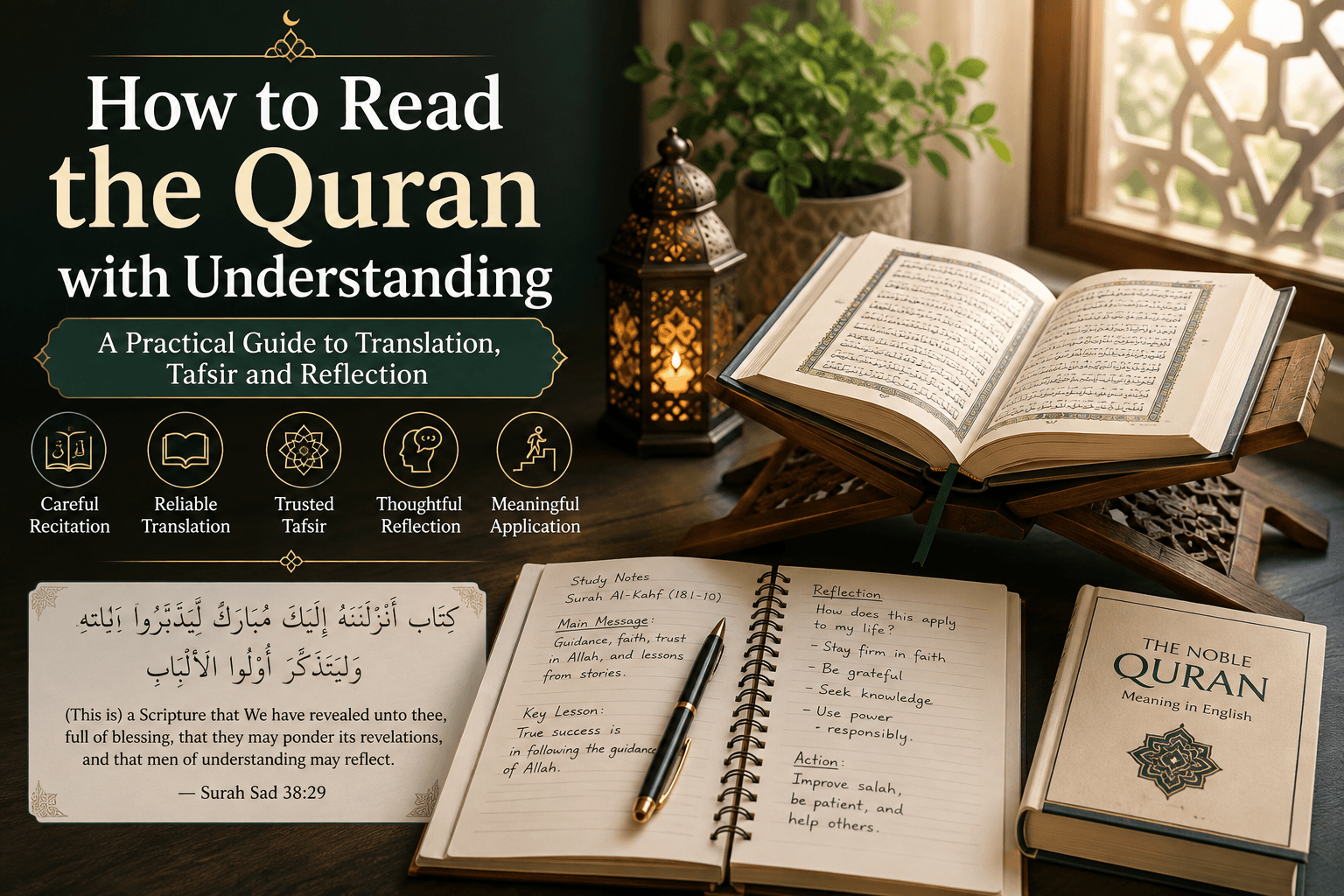
How to Read the Quran with Understanding
Learn how to read the Quran with understanding through careful recitation, reliable translations, trusted tafsir, thoughtful reflection, and practical application.
- Written by
- Zain Qalandar Shah
- Islamic reviewer
- Islamic scholarly review pending
- Last reviewed: Not yet reviewed
- Last content update
- Reading time
- 18 min read
First published
Reading the Quran with understanding does not mean that you must become an Arabic scholar before opening it.
You can begin by reciting a short passage, reading a reliable translation, studying its context, consulting trusted explanation, and asking what the passage is teaching you.
Understanding develops gradually. Some verses are immediately clear, while others involve language, history, theology, law, or differences of scholarly interpretation. A sincere reader learns to benefit from what is clear while seeking qualified guidance where deeper knowledge is required.
The aim is not to produce a personal interpretation of every verse. It is to listen carefully to the Quran, understand its message responsibly, and allow its guidance to influence your beliefs and actions.
The Quran invites people to reflect
The Quran describes itself as a blessed Book revealed so that people may reflect upon its verses and receive a reminder.
كِتَٰبٌ أَنزَلۡنَٰهُ إِلَيۡكَ مُبَٰرَكٞ لِّيَدَّبَّرُوٓاْ ءَايَٰتِهِۦ وَلِيَتَذَكَّرَ أُوْلُواْ ٱلۡأَلۡبَٰبِ
Urdu translation · Fatah Muhammad Jalandhari
(یہ) کتاب جو ہم نے تم پر نازل کی ہے بابرکت ہے تاکہ لوگ اس کی آیتوں میں غور کریں اور تاکہ اہل عقل نصیحت پکڑیں
English translation · Marmaduke Pickthall
(This is) a Scripture that We have revealed unto thee, full of blessing, that they may ponder its revelations, and that men of understanding may reflect.
Reflection is therefore not separate from Quran reading. It is one of the purposes for which the Book was revealed.
However, reflection should remain connected to the actual words, context, and established explanation of the Quran. It should not become an opportunity to place any personal idea into a verse.
A responsible reader asks:
- What is the verse actually saying?
- Who or what is being addressed?
- What appears before and after it?
- Is the passage a command, story, warning, promise, prayer, or argument?
- How have recognised scholars explained difficult parts?
- What lesson can be applied without changing the verse's meaning?
What does reading with understanding mean?
Reading with understanding includes several connected activities.
Recitation
You begin with the Arabic Quran according to your current ability. Careful recitation keeps you connected to the revealed text itself.
Translation
A translation helps a non-Arabic reader access the meaning of the verses. It remains a human translation of Quranic meanings and is not identical to the Arabic Quran.
Tafsir
Tafsir offers explanation based on Arabic language, Prophetic teachings, the understanding of early Muslims, historical context, and scholarly analysis.
Reflection
Reflection means thinking seriously about the passage and allowing its message to challenge, remind, or guide you.
Application
Understanding becomes meaningful when it influences belief, worship, character, decisions, and relationships.
These steps support one another. Translation without recitation may disconnect a reader from the Arabic text. Recitation without any effort to understand may leave important guidance unexplored. Reflection without reliable knowledge may produce mistaken conclusions.
A balanced method brings them together.
Begin with a short passage
Trying to study several pages at once can become overwhelming, especially for a beginner.
Choose a short passage of approximately three to ten verses. In a narrative section, it may be better to read until the immediate scene or discussion is complete rather than stopping in the middle of an idea.
For example, you could begin with:
- Surah Al-Fatihah
- Surah Al-Asr
- Surah Al-Ikhlas
- The opening verses of Surah Al-Kahf
- A short passage about patience, gratitude, prayer, or the Hereafter
- A section already used in your daily salah
Reading a smaller section allows you to notice repeated words, connections between verses, and the main direction of the passage.
The aim is not to collect as many notes as possible. It is to understand one passage more carefully than before.
Read the Arabic slowly
Begin by reading or listening to the Arabic passage at a measured pace.
Even when your main goal is understanding, careful recitation remains important. Hearing the verses repeatedly can help you recognise their structure, repeated expressions, and emotional movement.
A simple approach is:
- Listen to a reliable reciter.
- Follow the Arabic text with your eyes.
- Recite according to your ability.
- Repeat any difficult verse.
- Mark words you want to study further.
Do not rush through the Arabic merely to reach the translation.
At the same time, do not wait until your recitation is perfect before beginning to understand what you are reading. Recitation and understanding can improve together.
Read one reliable translation
After reciting the passage, read a trusted translation in the language you understand best.
Choose a translation that clearly identifies its translator. Avoid anonymous images, social-media posts, or copied text with no source information.
Read the entire selected passage once before examining individual words. This helps you understand the overall message rather than treating every verse as an isolated statement.
Then read it again and notice:
- The main subject
- Important people or groups
- Commands and prohibitions
- Promises and warnings
- Causes and consequences
- Questions being answered
- Changes in speaker or audience
- Words or ideas that appear repeatedly
One reliable translation is usually enough for the first reading. Comparing many translations immediately may distract a beginner from the central meaning.
A second translation may be useful when a sentence remains unclear, but differences should be investigated rather than resolved by choosing whichever wording you personally prefer.
Do not treat a translation as the complete meaning
Every translation involves human choices.
Arabic words may contain shades of meaning that cannot be represented fully in one English or Urdu expression. Grammar, context, rhetorical style, and connections with other verses may also affect interpretation.
For this reason:
- A translation is a doorway to understanding.
- It is not a replacement for the Arabic Quran.
- It is not automatically a complete tafsir.
- It should not be used alone to issue religious rulings.
- Difficult wording should be checked in trusted commentary.
This does not make translation useless. It simply means that it should be used with honesty about what it can and cannot provide.
Read the verses in context
One of the most common mistakes in Quran study is reading a single verse without examining the passage around it.
A verse may form part of:
- A longer story
- A response to an objection
- A discussion about a specific group
- A legal passage
- A comparison between believers and disbelievers
- A description of the Hereafter
- A prayer made by a prophet
- A warning connected to earlier actions
Read several verses before and after the verse you are studying.
Ask:
- What subject was being discussed?
- Does the next verse complete the sentence or argument?
- Is a pronoun referring to someone mentioned earlier?
- Is the verse describing an event or giving a general instruction?
- Is the Quran quoting another person's words?
- Does the passage contain a condition or exception?
Context does not answer every scholarly question, but it prevents many basic misunderstandings.
Use a recognised tafsir
After reading the translation and considering the context, consult a recognised tafsir.
A useful tafsir may explain:
- Important Arabic words
- The connection between verses
- Historical background
- Related Quran passages
- Relevant authentic Hadith
- The understanding of early Muslim scholars
- Legal or theological issues
- Areas where scholars have differed
A beginner does not need to read several large commentaries for every verse. One accessible and reliable tafsir is enough for a regular study session.
When a topic is complex, you may later consult a more detailed work or ask a qualified teacher.
Do not assume that every website, video, social-media page, or speaker using the word “tafsir” is equally reliable. Check the author, translator, publisher, references, and scholarly reputation of the source.
The Prophet ﷺ explained the Quran
The Quran was not revealed without Prophetic teaching and explanation.
Surah An-Nahl 16:44 states that the Reminder was revealed to the Prophet ﷺ so that he could explain to people what had been sent down for them and so that they might reflect.
This means that Quran understanding cannot responsibly ignore the authentic Sunnah.
The Sunnah may explain:
- How a command is practised
- Details not fully stated in one verse
- The meaning of a difficult expression
- The circumstances connected to a passage
- How the Prophet ﷺ applied Quranic guidance
- How believers should understand related duties
At the same time, Hadith must be quoted accurately. A report should be checked for its collection, wording, and authenticity rather than copied from an unsourced post.
Learn from qualified teachers
The Prophet ﷺ praised those who learn the Quran and teach it.
Hadith reference
Learning and teaching the Quran
The best among you are those who learn the Quran and teach it.
Verification note: The narration encourages Quran learning and teaching. It does not mean that every person presenting Quran content is automatically a qualified teacher.
A teacher can help you understand:
- Why two translations use different wording
- Whether a verse is general or connected to a particular context
- Which tafsir sources are suitable for your level
- Whether a Hadith being quoted is authentic
- Where scholars agree or differ
- Whether your personal conclusion is supported by the passage
A qualified teacher should help you return to the Quran and reliable sources rather than encouraging dependence on unsupported personal claims.
Ask five questions about each passage
A simple set of questions can make Quran study more focused.
1. What is the passage saying?
Summarise the basic meaning in one or two sentences.
Do not begin with a hidden symbolic interpretation. Start with the clearest meaning supported by the text and reliable explanation.
2. What does it teach about Allah?
The passage may teach about Allah's mercy, knowledge, power, justice, forgiveness, guidance, or authority.
Avoid assigning a meaning that the passage itself does not support.
3. What does it teach about people?
Notice human attitudes and actions such as gratitude, patience, arrogance, repentance, sincerity, fear, generosity, or denial.
4. Is there a command, warning, promise, or example?
Identify what kind of guidance is being given.
A story may contain lessons without every action inside the story becoming a command for all readers.
5. What response does the passage call for?
The appropriate response may be belief, repentance, gratitude, caution, patience, worship, justice, or a change in behaviour.
Application should come after understanding, not before it.
Reflection is different from tafsir
Personal reflection and formal explanation are not the same thing.
A reflection may sound like:
“This verse reminds me not to become proud of temporary success.”
A tafsir claim may sound like:
“This verse specifically means that a certain modern event or person is being predicted.”
The first statement describes a personal lesson consistent with the verse. The second claims to define the verse's intended meaning and requires evidence.
When writing notes, separate these categories clearly:
- Verse meaning: What the translation and tafsir establish
- Key lesson: A general lesson supported by the passage
- Personal reflection: How the lesson relates to your situation
- Question: Something requiring further study
- Action: A responsible step you can take
This separation allows reflection without presenting personal thoughts as revelation.
The Quran warns against closed-hearted reading
The Quran asks whether people reflect upon it or whether there are locks upon their hearts.
أَفَلَا يَتَدَبَّرُونَ ٱلۡقُرۡءَانَ أَمۡ عَلَىٰ قُلُوبٍ أَقۡفَالُهَآ
Urdu translation · Fatah Muhammad Jalandhari
بھلا یہ لوگ قرآن میں غور نہیں کرتے یا (ان کے) دلوں پر قفل لگ رہے ہیں
English translation · Marmaduke Pickthall
Will they then not meditate on the Qur'an, or are there locks on the hearts?
Understanding the Quran is not only an intellectual exercise.
A person may know the translation of a verse but resist its guidance because it challenges pride, habits, desires, or social pressure.
Reflection therefore requires humility.
Ask yourself:
- Am I willing to accept guidance that corrects me?
- Am I reading only to prove someone else wrong?
- Do I ignore verses that challenge my own behaviour?
- Am I searching for truth or merely for confirmation?
- Does my study make me more sincere and responsible?
Knowledge should soften the heart and improve conduct rather than produce arrogance.
Connect related Quran verses carefully
The Quran often explains themes across several passages.
When studying patience, for example, you may find relevant verses in different surahs. When studying the story of Musa, different sections may emphasise different events or lessons.
Cross-references can deepen understanding, but they should be used carefully.
Do not assume that verses sharing one English keyword always discuss exactly the same issue. The Arabic word, sentence structure, and context may differ.
A trusted tafsir or Quran index can help identify meaningful connections.
When recording a cross-reference, note why it is relevant:
- Same subject
- Same person or event
- Similar command
- Additional detail
- Explanation of a term
- Contrast between two responses
Learn a small amount of Quranic Arabic
You do not need advanced Arabic before beginning Quran study, but gradual language learning can improve your understanding.
Start with:
- Frequently repeated Quranic words
- Common pronouns
- Basic verb patterns
- Singular and plural forms
- Common connecting words
- Words used in salah
- Names and attributes of Allah
- Repeated expressions in short surahs
Learning one word does not always reveal the full meaning of a verse. Words change meaning according to grammar and context.
Use word-by-word tools as learning aids, not as replacements for translation, tafsir, or qualified Arabic instruction.
A practical 20-minute study routine
The following is editorial study guidance, not a prescribed religious ritual.
Minutes 1–4: Recite the passage
Read three to ten verses slowly. Listen to a reliable reciter where necessary.
Minutes 5–8: Read the translation
Read one attributed translation of the entire passage.
Minutes 9–13: Read a short tafsir
Consult a recognised explanation and note the main context or lesson.
Minutes 14–17: Answer three questions
Write brief answers:
- What is the main message?
- What does the passage teach?
- What requires further clarification?
Minutes 18–20: Choose one response
Write one realistic action, dua, reminder, or behaviour connected to the passage.
The action should be supported by the meaning rather than invented from a symbolic interpretation.
An example of a Quran study note
Suppose you are studying a passage about gratitude.
Your notes might look like this:
Passage: Surah and verse numbers
Main meaning: The passage reminds people that their blessings come from Allah and warns against denying them.
Key words: Blessing, gratitude, remembrance
Tafsir note: Record one short explanation with its source.
Personal reflection: I often notice problems quickly but forget the ordinary blessings present every day.
Action: Write down three blessings and thank Allah for them after salah.
Question: Does the passage describe a particular historical group or a general human attitude?
This method is simple enough for regular use while keeping the source, meaning, reflection, and action separate.
How to choose a translation
A reliable translation should:
- Identify the translator
- Use clear and readable language
- Preserve verse numbering
- Avoid unexplained additions presented as Quran text
- Make explanatory insertions visually clear
- Be published or hosted by a trustworthy source
- Allow the reader to verify individual verses
No translation will communicate every feature of the Arabic perfectly.
Choose one translation as your main reading version. Use another only when clarification is needed.
When two translations differ significantly, consult tafsir or ask someone qualified rather than deciding that one must be dishonest or incorrect.
How to choose a tafsir
Before relying on a tafsir, consider:
- Who wrote it?
- Who translated or edited it?
- Does it cite Quran and Hadith sources?
- Is the language suitable for your level?
- Does it distinguish strong and weak reports?
- Does it acknowledge recognised scholarly differences?
- Is it known and used by qualified scholars?
- Does it avoid unsupported sensational claims?
A brief tafsir may be useful for daily study, while a detailed commentary may be better for research.
Do not measure reliability by writing style alone. A confident or emotional speaker can still misquote sources.
Can you reflect without knowing Arabic?
Yes.
A non-Arabic reader can understand and reflect through a trusted translation and tafsir while continuing to learn Arabic.
Many important Quranic teachings are clearly accessible through reliable translations. You can understand commands to worship Allah, act justly, show gratitude, avoid arrogance, repent, and prepare for the Hereafter.
However, acknowledge the limits of translation.
When a conclusion depends on precise grammar, legal terminology, variant interpretation, or subtle rhetorical language, seek deeper scholarly explanation.
Arabic learning should strengthen Quran study, but lack of fluency should not become an excuse to avoid all understanding.
Can AI tools explain the Quran?
AI tools may help with limited supporting tasks such as:
- Organising study notes
- Creating a reading schedule
- Finding questions to investigate
- Comparing text you have already verified
- Simplifying your own notes
- Creating flashcards from trusted material
AI should not be treated as an independent religious authority.
It may:
- Invent references
- Misquote verses or Hadith
- Confuse translation with tafsir
- Present weak reports as authentic
- Ignore differences between scholars
- Produce confident but unsupported explanations
Always verify Arabic text, translations, Hadith references, and religious rulings through dependable sources and qualified teachers.
Do not publish an AI-generated Quran explanation simply because it sounds fluent.
Turn understanding into action
The Quran was not revealed only to produce information.
After understanding a passage, identify a response that is realistic and connected to its message.
Examples include:
- Making a sincere dua
- Correcting an unfair action
- Asking forgiveness
- Showing gratitude
- Improving a family relationship
- Avoiding a harmful habit
- Fulfilling a responsibility
- Learning a neglected religious duty
- Becoming more careful about speech
- Giving charity
- Remaining patient without abandoning responsible action
Avoid turning every verse into a vague motivational quote.
Some passages call for hope, while others warn, establish belief, teach history, describe the Hereafter, or provide legal guidance. The response should respect the type of passage being read.
Common mistakes to avoid
Reading only isolated verses
A verse separated from its surrounding passage can easily be misunderstood.
Read what comes before and after it.
Depending on anonymous social-media posts
A beautiful design does not prove that a translation, Hadith, or explanation is accurate.
Verify the source.
Treating every personal thought as tafsir
A meaningful personal lesson is not automatically the intended explanation of the verse.
Label reflections honestly.
Searching only for what you already believe
Quran study should correct the reader, not merely confirm personal opinions.
Be willing to learn something unexpected.
Using translation alone for legal rulings
Legal rulings may require Arabic analysis, Hadith evidence, principles of jurisprudence, and knowledge of scholarly differences.
Ask a qualified scholar.
Ignoring difficult verses
Do not skip every passage that feels challenging.
Record the question and seek reliable explanation.
Reading too much in one session
A large amount of information may produce little lasting understanding.
Study a small passage consistently.
Collecting notes without changing behaviour
Notes are useful, but the purpose of guidance includes belief and action.
Choose one practical response.
Questions that require qualified scholarly guidance
Some passages involve matters that should not be resolved through personal reflection alone.
These may include:
- Detailed beliefs and theological questions
- Halal and haram rulings
- Marriage, divorce, and inheritance
- Financial transactions
- Criminal punishments
- Warfare and international relations
- Abrogation
- Verses with several recognised interpretations
- Reports about reasons for revelation
- Claims about scientific predictions
- Applying verses to specific individuals or modern events
A beginner may study what the passage generally teaches while leaving specialised rulings to qualified scholars.
Asking for help is not a failure to reflect. It is part of responsible learning.
Frequently asked questions
How can I begin understanding the Quran?
Start with a short passage. Recite it, read one reliable translation, examine the surrounding verses, consult a trusted tafsir, and write one lesson and one question.
Is reading an English or Urdu translation enough?
A translation provides important access to Quranic meanings, but it does not contain every detail of the Arabic text or replace tafsir and qualified explanation.
Should I read tafsir before or after translation?
Read the passage and translation first, then consult tafsir to understand context, important words, and deeper explanation.
Which surah should I study first?
Short surahs such as Al-Fatihah, Al-Asr, Al-Ikhlas, Al-Falaq, and An-Nas are manageable starting points. You may also begin with a passage you regularly recite in salah.
Can I write my own Quran reflections?
Yes, provided you clearly label them as personal reflections and do not present them as the certain intended meaning of the verse without evidence.
Do I need to know Arabic?
You can begin understanding through reliable translations and tafsir. Learning Arabic gradually will deepen your study and reduce dependence on translation.
How much should I study each day?
There is no single required study amount. A focused session of fifteen to twenty minutes on a small passage can be more beneficial than rushing through several pages.
Can I use several translations?
Yes, but begin with one main trusted translation. Compare another when wording is unclear, then consult tafsir where significant differences remain.
Can AI write Quran tafsir for me?
AI may help organise verified material but should not be trusted as an independent source of tafsir, Hadith grading, or religious rulings.
What should I do when I do not understand a verse?
Record the verse and your question. Read the surrounding passage, consult a recognised tafsir, and ask a qualified teacher or scholar.
Final advice
Reading the Quran with understanding is not a task completed in one month or one course.
It is a lifelong relationship.
Begin with a small passage. Read it carefully. Use a reliable translation. Consult trustworthy explanation. Ask honest questions. Write reflections with humility. Apply what is clear, and seek help where the subject requires deeper knowledge.
You do not need to understand everything before benefiting from something.
At the same time, sincerity does not remove the need for accuracy.
Approach the Quran with an open heart, a careful mind, and a willingness to be guided.
Editorial review status
The Quran verses and Hadith reference used in this article are linked to their respective source pages.
The study methods, note-taking system, and suggested routine are presented as practical editorial guidance rather than prescribed acts of worship.
A qualified Islamic scholar has not yet completed the theological review of this article. Its reviewer status should remain visible as pending until an appropriate reviewer has examined and approved the content.
Sources & references
Review the cited source and verification status for each reference used in this article.
Quranic statement describing the Book as blessed and revealed for reflection and reminder.
Quranic question calling people to reflect upon the Quran.
Quranic reference to the Prophet's role in explaining what was revealed to people.
Authentic narration concerning the virtue of learning and teaching the Quran.
Quran passage relevant to clear and less immediately clear verses and the danger of pursuing misleading interpretations.
Read in the Quran
Related Surahs
Continue learning
Related articles
How to Start Reading the Quran: A Beginner’s Guide
Learn how to begin reading the Quran with a simple daily routine, careful recitation, a trusted translation, reflection, and guidance from a qualified teacher.

Surah Yaseen: Meaning, Main Themes and Authentic Benefits
Understand the meaning and major themes of Surah Yaseen, along with what authentic sources do—and do not—say about its special benefits.

Why Read Surah Al-Kahf on Friday? Virtues and Lessons
Learn why Muslims read Surah Al-Kahf on Friday, what the authentic reports say about its virtue, and the major lessons found throughout Surah 18.