

Daily Quran Reading Plan: Build a Consistent Routine
Create a realistic daily Quran reading plan with flexible 10, 20, and 30-minute routines, measured recitation, translation, reflection, and achievable completion goals.
- Written by
- Zain Qalandar Shah
- Islamic reviewer
- Islamic scholarly review pending
- Last reviewed: Not yet reviewed
- Last content update
- Reading time
- 15 min read
First published
A daily Quran reading plan does not need to begin with a large number of pages.
The most useful plan is one that matches your present ability, fits naturally into your day, and allows you to continue without turning Quran reading into a source of constant pressure.
For one person, a realistic routine may be ten minutes after Fajr. Another person may read one page after each salah. Someone working toward a Quran completion may divide one juz across the day.
The exact amount can differ. What matters is that the routine remains sincere, manageable, and connected to careful recitation and understanding.
This guide offers several flexible plans. They are practical suggestions, not fixed religious quotas.
Consistency is more important than an ambitious beginning
Many reading plans fail because they begin with excitement rather than a realistic understanding of daily life.
A person decides to read a large section every day, misses one or two sessions, falls behind, and then abandons the plan completely.
A smaller routine may look less impressive, but it is often easier to maintain.
Sahih al-Bukhari records the general principle that the deeds most loved by Allah are those performed regularly, even when they are small.
Hadith reference
Regular deeds, even when small
The deeds most loved by Allah are those performed regularly, even when they are few.
Verification note: This is a general principle about consistency. It does not prescribe a specific daily number of Quran pages or minutes.
A daily Quran routine should therefore be built around what you can usually continue, not what you can manage only on your most energetic day.
Five careful verses read regularly are better for habit-building than a large target that repeatedly causes you to stop.
Read at a measured pace
A daily target should never force you to rush through the Quran merely to complete a number.
The Quran instructs the Prophet ﷺ to recite in a measured manner.
أَوۡ زِدۡ عَلَيۡهِ وَرَتِّلِ ٱلۡقُرۡءَانَ تَرۡتِيلًا
Urdu translation · Fatah Muhammad Jalandhari
یا اس سے کچھ کم یا کچھ زیادہ اور قرآن کو ٹھہر ٹھہر کر پڑھا کرو
English translation · Marmaduke Pickthall
Or add (a little) thereto - and chant the Qur'an in measure,
Measured recitation includes reading with attention rather than racing to finish.
For a learner, this may involve:
- Pausing at a difficult word
- Listening to a reliable reciter
- Repeating a verse
- Correcting pronunciation
- Following stopping signs carefully
- Asking a teacher about recurring mistakes
A daily plan should support careful reading. If your chosen target makes careful recitation impossible, reduce the amount.
Choose your main purpose
Before selecting a daily schedule, decide what you are currently trying to achieve.
Your main goal may be:
- Building a consistent relationship with the Quran
- Improving Arabic reading
- Completing the Quran over a particular period
- Understanding a translation
- Studying selected passages with tafsir
- Memorising short surahs
- Reviewing previously memorised verses
One routine cannot give equal attention to every goal.
A completion plan may cover more verses but leave less time for detailed study. A reflection plan may cover only a few verses while producing deeper understanding.
Both can be valuable when their purpose is clear.
Plan 1: A simple 10-minute daily routine
This plan is suitable for beginners, busy students, working adults, and anyone rebuilding a Quran habit.
Minutes 1–2: Prepare
Move away from distractions and open the Quran or a trustworthy Quran application.
Seek refuge with Allah before recitation, as instructed in Surah An-Nahl 16:98.
Minutes 3–7: Recite
Read a small passage slowly.
Depending on your ability, this could be:
- Three to five verses
- Half a page
- One short surah
- A passage you are learning with a teacher
Do not increase the amount merely because another person's plan is larger.
Minutes 8–9: Read the translation
Read the translation of the same verses.
Try to identify the main subject rather than analysing every detail immediately.
Minute 10: Record one point
Write one brief note:
- One lesson
- One question
- One word to learn
- One action to remember
Ten minutes may appear small, but a routine that continues every day can create meaningful progress.
Plan 2: A balanced 20-minute Quran routine
This plan combines recitation, listening, translation, and reflection.
Minutes 1–2: Prepare for reading
Remove avoidable distractions and begin with a clear intention.
Minutes 3–10: Recite the passage
Read approximately half a page, one page, or a short connected passage according to your level.
Focus on clarity rather than speed.
Minutes 11–14: Listen and repeat
Listen to a trusted reciter and repeat difficult words or verses.
This part is especially valuable for readers improving pronunciation.
Minutes 15–18: Read the translation
Read an attributed Urdu or English translation of the same passage.
Notice whether the verses contain:
- A command
- A warning
- A promise
- A story
- A dua
- A description of Allah
- A reminder of the Hereafter
Minutes 19–20: Reflect
Write one sentence answering:
What should I remember from this passage today?
This routine gives each part a small amount of attention without becoming too demanding.
Plan 3: A 30-minute reading and understanding routine
This plan is suitable for readers who want to combine regular recitation with more thoughtful study.
Minutes 1–12: Arabic recitation
Read a connected section at a measured pace.
Mark any word or verse that requires pronunciation help.
Minutes 13–17: Listening practice
Listen to the same section while following the Arabic text.
Repeat difficult portions.
Minutes 18–22: Translation
Read one trusted translation of the complete passage.
Avoid switching between too many translations during the first reading.
Minutes 23–27: Tafsir
Read a short explanation from a recognised tafsir.
Look for:
- Context
- Important Arabic words
- Connections between verses
- Relevant authentic Hadith
- Lessons clearly supported by the passage
Minutes 28–30: Notes and application
Write:
- The main message
- One question
- One responsible action or reminder
This plan covers less material than a fast completion schedule, but it gives more space for understanding.
Plan 4: Read after each salah
Some people struggle to protect one long reading period but can manage several short sessions.
In that case, divide the daily reading around the five prayers.
A simple example is:
- After Fajr: one short passage
- After Dhuhr: continue the next passage
- After Asr: review difficult verses
- After Maghrib: read the translation
- After Isha: write one lesson or question
Another approach is to read one page after each salah.
This would produce five pages on days when all five sessions are completed. However, page counts vary between mushaf editions, so the plan should be based on the copy you actually use.
This schedule is practical guidance. Reading a certain number of pages after each salah is not being presented as a prescribed Sunnah practice.
Plan 5: Complete the Quran in about 30 days
The Quran is commonly divided into 30 juz. Reading approximately one juz each day allows a person to complete it in about one month.
Sahih al-Bukhari records that the Prophet ﷺ instructed Abdullah ibn Amr to recite the Quran over one month. When Abdullah said that he had the strength to do more, the period was eventually reduced to seven days, with instruction not to complete it in less than that period.
Hadith reference
Completing the Quran over one month
The Prophet instructed Abdullah ibn Amr to recite the whole Quran in one month, and later permitted seven days when he said he had greater ability.
Verification note: The narration concerns guidance given to Abdullah ibn Amr. This article does not present a monthly completion as an obligation upon every Muslim.
A one-juz-per-day plan may be divided into:
- Half a juz in the morning and half in the evening
- A portion after each salah
- Several smaller sessions throughout the day
- One longer uninterrupted reading period
The length of a juz is not identical in every section, so some days may take longer than others.
If the Islamic month has 29 days, the final portion may be divided across earlier days or completed with an additional session.
The goal should not cause careless recitation, neglect of responsibilities, or complete abandonment of reflection.
Plan 6: Complete the Quran in about 60 days
A two-month plan may be more manageable for readers who find one juz every day difficult.
Read approximately half a juz each day.
You may divide it into:
- One-quarter juz in the morning
- One-quarter juz in the evening
This schedule offers more time for careful recitation while maintaining a clear completion goal.
Missing one session is also easier to recover from than under a very demanding plan.
Plan 7: A plan for complete beginners
A beginner learning Arabic should not measure progress only by completed pages.
Use a skill-based plan.
Daily beginner routine
- Review five Arabic letters or one reading rule.
- Read one short line with a teacher or recorded lesson.
- Repeat difficult sounds.
- Recite one familiar short surah.
- Read the translation of two or three verses.
- Record one question.
Your daily achievement may be correctly recognising one word that was previously difficult.
That is still progress.
Transliteration may provide temporary help, but it cannot represent every Arabic sound accurately. Gradually move toward reading the Arabic script with guidance from a qualified teacher.
Plan 8: A daily translation and reflection plan
Some readers already recite regularly but rarely study meaning.
For this goal, select a small connected passage each day.
A simple method is:
- Recite the verses.
- Read the translation.
- Read the surrounding verses.
- Consult a short tafsir.
- Write the main message.
- Record one practical response.
The Quran describes itself as a blessed Book revealed so that people may reflect upon its verses.
كِتَٰبٌ أَنزَلۡنَٰهُ إِلَيۡكَ مُبَٰرَكٞ لِّيَدَّبَّرُوٓاْ ءَايَٰتِهِۦ وَلِيَتَذَكَّرَ أُوْلُواْ ٱلۡأَلۡبَٰبِ
Urdu translation · Fatah Muhammad Jalandhari
(یہ) کتاب جو ہم نے تم پر نازل کی ہے بابرکت ہے تاکہ لوگ اس کی آیتوں میں غور کریں اور تاکہ اہل عقل نصیحت پکڑیں
English translation · Marmaduke Pickthall
(This is) a Scripture that We have revealed unto thee, full of blessing, that they may ponder its revelations, and that men of understanding may reflect.
Reflection should remain connected to reliable translation, context, and tafsir.
A personal thought should not be presented as the definite intended meaning of a verse without evidence.
How much Quran should you read daily?
There is no single daily amount that suits every reader.
Consider:
- Your Arabic reading level
- Available time
- Concentration
- Family and work responsibilities
- Whether you are studying translation
- Whether you are correcting pronunciation
- Your current health and energy
- Whether the plan has continued successfully before
Choose a minimum target and an optional target.
For example:
Minimum: Five verses or ten minutes Optional: One full page or twenty minutes
On a difficult day, complete the minimum. On a less busy day, continue toward the optional goal.
This approach protects consistency without preventing additional reading.
The reward of Quran recitation
An authentic report in Jami at-Tirmidhi describes reward for reciting each letter of Allah's Book.
Hadith reference
Reward for every letter recited
Whoever recites a letter from Allah's Book receives a good deed, and each good deed is multiplied ten times.
Verification note: The narration encourages Quran recitation. It should not be used to invent an exact spiritual calculation for a particular page, surah, or reading schedule.
This encouragement gives value to small amounts of sincere recitation.
A reader should not think that a short session is worthless merely because it did not complete a large target.
Choose a dependable time
A reading plan is easier to maintain when it has a regular place in the day.
Possible times include:
- After Fajr
- Before beginning work or study
- During a quiet lunch break
- After Maghrib
- Before sleeping
- Immediately after another established habit
Choose a time when interruptions are usually limited.
Do not select a schedule only because it sounds spiritually impressive. Select one you can protect.
It may also help to keep your mushaf, notebook, or reading application ready before the scheduled time.
Reduce distractions before beginning
A ten-minute session can disappear quickly when notifications remain active.
Before reading:
- Silence unnecessary notifications
- Place the phone away unless using a Quran application
- Close unrelated browser tabs
- Inform family members when you need a short uninterrupted period
- Keep your Quran and notebook in one consistent location
The aim is not to create a perfect environment. It is to remove the most avoidable distractions.
Use one mushaf or application consistently
Regularly using the same mushaf can help some readers remember where verses appear on a page.
A Quran application can also be useful when it provides:
- Accurate Arabic text
- Named translations
- Verse-by-verse audio
- Reliable surah and verse numbering
- Bookmarks
- Reading progress
- Tafsir from identified sources
Features should support reading rather than turn the routine into endless application settings and statistics.
Track your routine without becoming controlled by it
A simple tracker can help you see whether the plan is realistic.
Record:
- Date
- Surah and verses
- Reading duration
- Translation completed
- One lesson
- Questions for a teacher
Do not allow the tracker to become more important than the Quran itself.
A broken streak does not mean the relationship has ended.
Tracking should encourage return, not produce shame.
What to do after missing a day
Missing a day is common.
Do not respond by abandoning the plan.
Use one of these approaches:
Resume normally
Continue from where you stopped without trying to recover everything immediately.
Divide the missed portion
Add a small amount across the next several days.
Reduce the target
If missed sessions occur repeatedly, the schedule may be too demanding.
A plan that needs frequent emergency recovery is probably not yet sustainable.
Returning calmly is more useful than repeatedly beginning an extreme plan.
Create a weekly review
Once a week, review your routine.
Ask:
- How many days did I read?
- Was the target realistic?
- Did I rush?
- Did I understand anything from the translation?
- Which pronunciation mistakes kept returning?
- What questions should I ask a teacher?
- Should the target remain the same?
Do not increase the amount automatically every week.
Sometimes the best improvement is better concentration rather than more pages.
Balance recitation, understanding, and action
A complete Quran routine may include three areas:
Recitation
Reading the Arabic text carefully.
Understanding
Reading translation and trusted tafsir.
Response
Allowing the guidance to affect belief, worship, character, and behaviour.
Not every session needs to give equal time to all three.
You may have:
- Regular recitation days
- A longer weekly tafsir session
- A separate memorisation session
- A monthly review of notes
The plan should remain organised enough to be useful but flexible enough to survive real life.
A sample seven-day plan
This is an example, not a prescribed weekly schedule.
Monday
Recite a short passage and read its translation.
Tuesday
Continue the next passage and note difficult Arabic words.
Wednesday
Listen to both passages and repeat pronunciation.
Thursday
Read a short tafsir of the week's verses.
Friday
Read Surah Al-Kahf and reflect on one of its major narratives.
Saturday
Review notes and ask a teacher about unclear points.
Sunday
Read freely without a study target or revise memorised surahs.
A varied plan may help readers who find the same routine every day difficult.
Common mistakes to avoid
Starting with an unrealistic amount
A large initial target may create excitement but often becomes difficult to maintain.
Begin below your maximum ability.
Reading too quickly
Finishing pages should not replace careful recitation.
Reduce the target if you are consistently rushing.
Ignoring translation completely
Regularly include at least a small amount of understanding, especially if you can access a trusted translation.
Using too many resources
Several applications, translations, reciters, and notebooks can make a simple routine unnecessarily complicated.
Choose a small number of reliable tools.
Treating a missed day as failure
Missing a session requires returning, not abandoning the entire routine.
Inventing religious promises
Do not claim that reading a certain number of pages guarantees wealth, healing, marriage, or fulfilment of every request without reliable evidence.
Comparing your plan with others
A student, parent, full-time worker, Quran teacher, and Arabic beginner will not necessarily follow the same schedule.
Measure progress against your own realistic ability.
Focusing only on completion dates
Completing the Quran is valuable, but the Quran should not become a book you rush through without listening to its guidance.
Frequently asked questions
How many pages of the Quran should I read daily?
There is no universal daily page requirement. Choose an amount that allows careful reading and consistency. Beginners may start with a few verses, half a page, or ten minutes.
How can I complete the Quran in 30 days?
Read approximately one juz each day. Divide it into smaller sessions if reading the full juz at once is difficult.
Can I divide my daily Quran reading?
Yes. You may read in several short sessions throughout the day rather than one long sitting.
Is ten minutes of Quran reading enough?
Ten consistent minutes can be a strong starting point. Increase the amount gradually when the routine becomes stable.
Should I read Arabic or translation daily?
Where possible, recite the Arabic and read the translation of the same passage. Adjust the balance according to your current learning goal.
What should I do if I cannot read Arabic?
Begin learning the Arabic script with a qualified teacher or structured beginner course. You may read a trusted translation for understanding while continuing your Arabic lessons.
Should I read one juz every day?
One juz daily is useful for someone seeking an approximately monthly completion and able to maintain it carefully. It is not a universal obligation.
What happens if I miss my daily target?
Resume from where you stopped. You may divide the missed portion across later days, but do not create a punishment plan that causes you to quit.
Is listening to the Quran part of a reading plan?
Listening can improve pronunciation, memorisation, and reflection. However, when a narration specifically refers to recitation, this article does not claim that passive listening carries the identical stated virtue.
Should I track my Quran reading streak?
A tracker can support consistency, but it should not become a source of pride, guilt, or pressure. The purpose is to help you return to the Quran.
Final advice
A daily Quran reading plan succeeds when it helps you return regularly.
Start with an amount you can protect. Read carefully. Include some understanding. Ask for help when pronunciation or meaning is unclear.
Do not wait for a perfect schedule.
Some days may allow a long session. Other days may allow only a few verses. Keep a realistic minimum and return after interruptions.
The goal is not merely to maintain a streak or reach a completion date.
The goal is to build a lasting relationship with the Quran—through recitation, understanding, reflection, and sincere response.
Editorial review status
The Quran verses and Hadith references used in this article are linked to their respective source pages.
The 10-minute, 20-minute, 30-minute, after-salah, monthly, and two-month plans are practical editorial suggestions. They are not presented as prescribed religious rituals or obligatory daily quotas.
A qualified Islamic scholar has not yet completed the theological review of this article. Its reviewer status should remain visible as pending until an appropriate reviewer has examined and approved the content.
Sources & references
Review the cited source and verification status for each reference used in this article.
Quranic instruction to recite in a measured manner.
Quranic statement concerning reflection upon the verses of the blessed Book.
Instruction to seek refuge with Allah when reciting the Quran.
General principle concerning regular deeds, even when small.
Guidance given to Abdullah ibn Amr concerning completing the Quran over one month and later seven days.
Reward for reciting each letter from Allah's Book; displayed grade: Hasan (Darussalam).
Read in the Quran
Related Surahs
Continue learning
Related articles
How to Start Reading the Quran: A Beginner’s Guide
Learn how to begin reading the Quran with a simple daily routine, careful recitation, a trusted translation, reflection, and guidance from a qualified teacher.
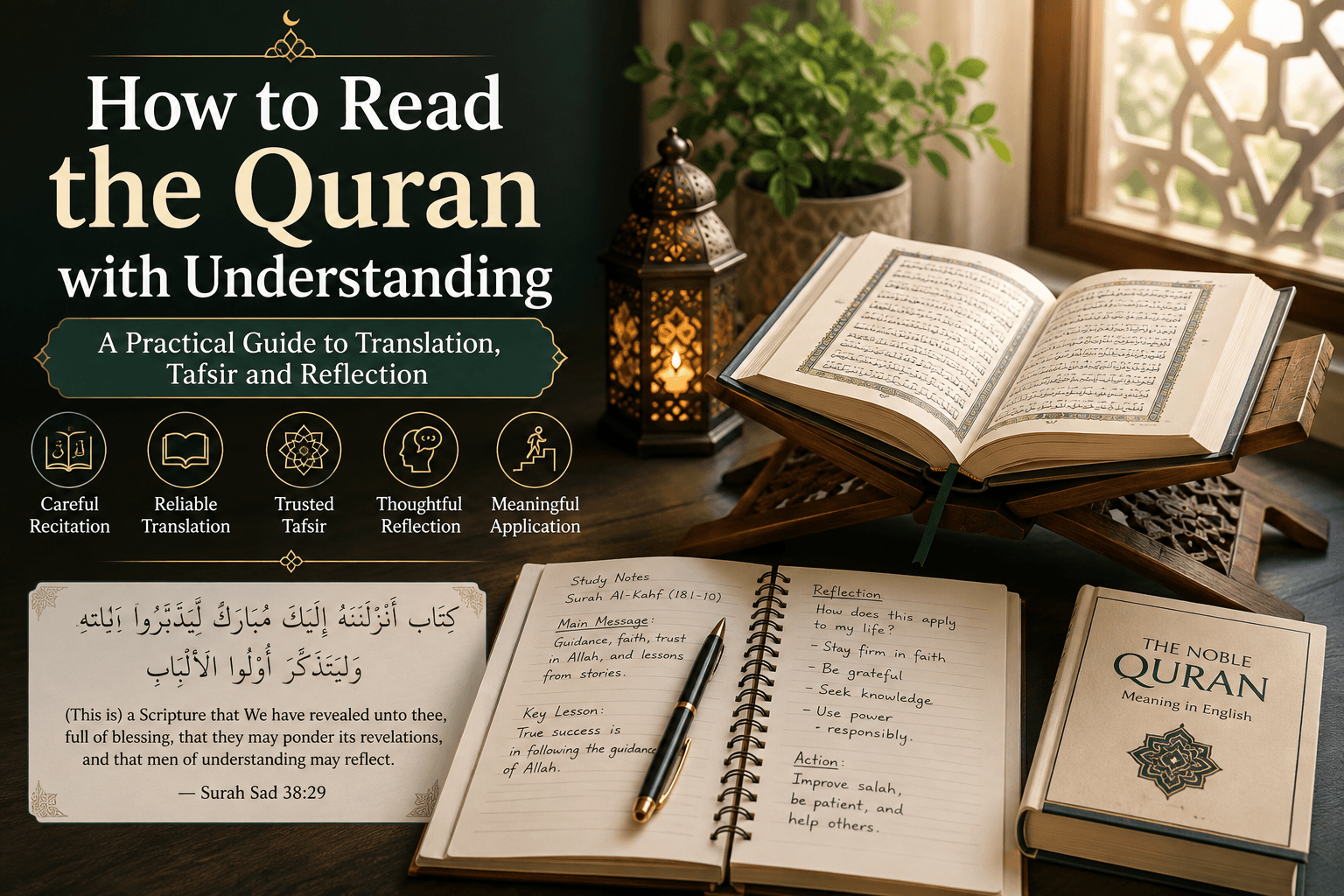
How to Read the Quran with Understanding
Learn how to read the Quran with understanding through careful recitation, reliable translations, trusted tafsir, thoughtful reflection, and practical application.

Why Read Surah Al-Kahf on Friday? Virtues and Lessons
Learn why Muslims read Surah Al-Kahf on Friday, what the authentic reports say about its virtue, and the major lessons found throughout Surah 18.