
Tafsir vs Translation: What Is the Difference?
Understand the difference between Quran translation and tafsir, what each one provides, their limitations, and how beginners can use both responsibly.
- Written by
- Zain Qalandar Shah
- Islamic reviewer
- Islamic scholarly review pending
- Last reviewed: Not yet reviewed
- Last content update
- Reading time
- 19 min read
First published
A Quran translation and a tafsir may appear to serve the same purpose, but they are not the same thing.
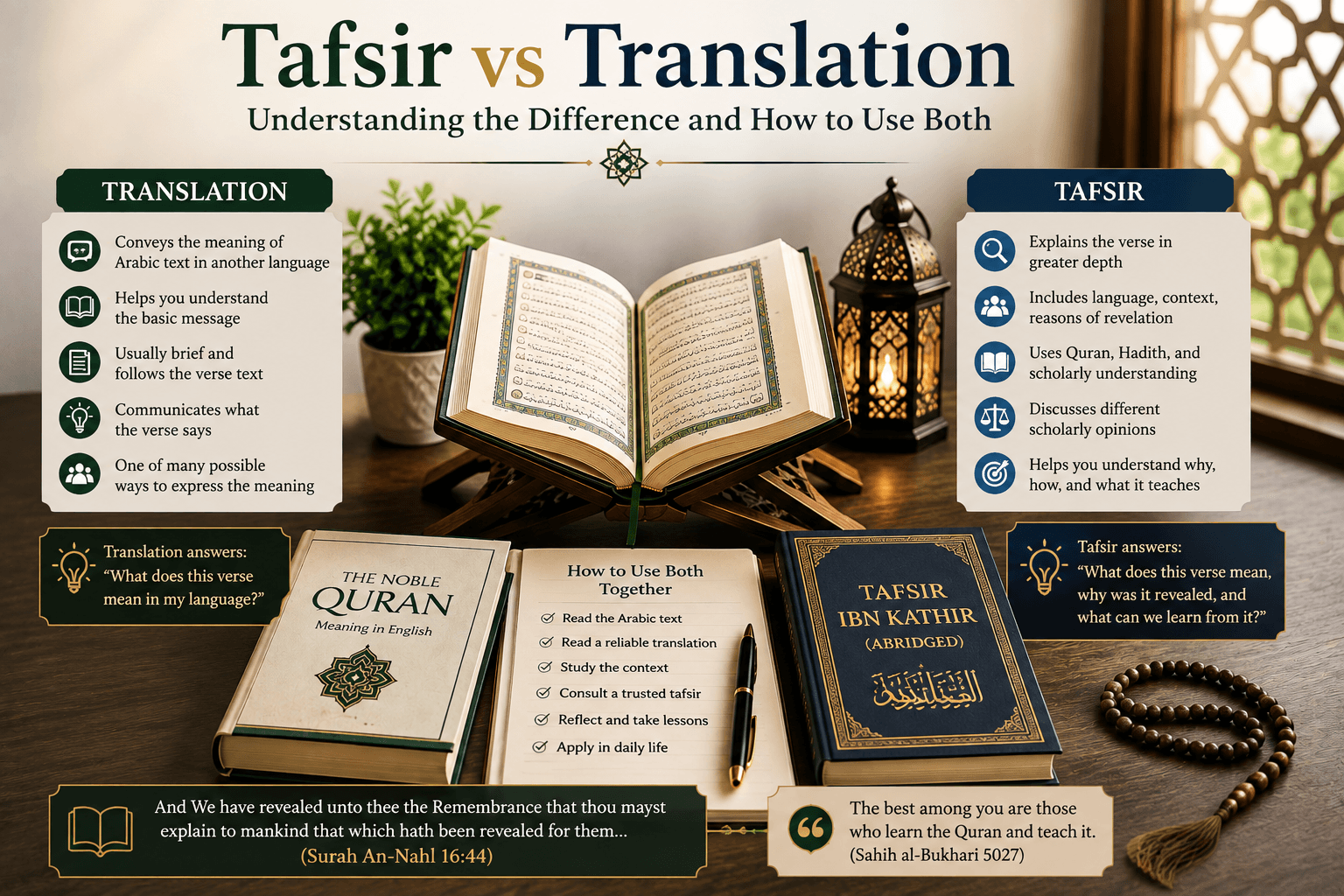
A translation attempts to communicate the meaning of the Arabic Quran in another language. Tafsir goes further by explaining the language, context, themes, connections, Prophetic teachings, and scholarly understanding related to the verses.
For a beginner, the simplest distinction is:
- Translation tells you what the verse means in another language.
- Tafsir helps explain why the verse says it, how it should be understood, and how it connects with other Islamic sources.
Both are valuable, but neither should be confused with the original Arabic Quran.
This guide explains the difference between translation and tafsir, what each one can provide, and how to use them together responsibly.
What is a Quran translation?
A Quran translation is an attempt to convey the meaning of the Arabic verses in another language, such as English, Urdu, Turkish, Indonesian, or French.
It allows a reader who does not understand Arabic to access the basic message of a passage.
A translation may help you recognise:
- Commands and prohibitions
- Stories of prophets and earlier communities
- Descriptions of Allah
- Promises and warnings
- Supplications
- Moral teachings
- References to the Hereafter
- General legal guidance
- Major themes of a surah
For example, an English translation may tell the reader that a passage commands patience, warns against arrogance, or describes the Day of Judgment.
That is extremely valuable for understanding.
However, a translation remains a human effort to communicate Quranic meaning. It is not identical to the Arabic Quran itself.
Why is a translation not the Quran itself?
The Quran was revealed in Arabic.
When its meaning is expressed in English or Urdu, the translator must choose words that appear to represent the Arabic meaning as accurately as possible.
This process involves interpretation.
One Arabic word may carry:
- More than one shade of meaning
- A grammatical meaning not easily expressed in English
- A connection with other Quranic words
- A legal or theological implication
- A rhetorical effect
- A meaning shaped by the surrounding passage
A translator may need several English words to represent one Arabic expression. In other cases, one English word may be used even though the Arabic term contains a wider meaning.
For this reason, translations are often described as translations of the meanings of the Quran.
The Arabic text remains the revealed Quran, while the translation is a human attempt to communicate its meaning.
What is tafsir?
Tafsir means explanation or interpretation of the Quran.
A tafsir does not simply replace Arabic words with words from another language. It examines the verse more deeply.
Depending on the tafsir, it may discuss:
- The meanings of important Arabic words
- Arabic grammar
- The relationship between sentences
- The verses before and after
- The reason or historical setting of revelation
- Related verses elsewhere in the Quran
- Authentic Hadith
- Explanations given by the Prophet ﷺ
- Understanding reported from the Companions
- Views of early Muslim scholars
- Legal implications
- Theological questions
- Differences between recognised interpretations
- Practical lessons from the passage
A tafsir may explain only a few verses across several pages.
This is because its goal is not merely to translate the wording. Its goal is to help the reader understand the passage more carefully.
A simple comparison
| Translation | Tafsir |
|---|---|
| Communicates meaning in another language | Explains the verse in greater depth |
| Usually brief | May be short or highly detailed |
| Follows the verse text closely | Discusses language, context, Hadith, and scholarly interpretation |
| Helps non-Arabic readers access the message | Helps readers understand why and how a verse should be interpreted |
| May give one preferred wording | May discuss several possible meanings |
| Does not usually explain every background detail | Often provides historical and thematic background |
| Useful for daily reading | Useful for deeper study |
| Still contains interpretive choices | Contains more extensive scholarly interpretation |
Translation and tafsir are connected, but they answer different questions.
A translation usually answers:
“What does this verse say in my language?”
A tafsir may answer:
“What does this expression mean, what is its context, how did the Prophet ﷺ and early scholars explain it, and what conclusions can responsibly be drawn from it?”
The Prophet ﷺ explained the Quran
Understanding the Quran cannot be separated from the explanation and teaching of the Prophet Muhammad ﷺ.
The Quran states that the Reminder was revealed to the Prophet so that he could explain to people what had been sent down to them.
بِٱلۡبَيِّنَٰتِ وَٱلزُّبُرِۗ وَأَنزَلۡنَآ إِلَيۡكَ ٱلذِّكۡرَ لِتُبَيِّنَ لِلنَّاسِ مَا نُزِّلَ إِلَيۡهِمۡ وَلَعَلَّهُمۡ يَتَفَكَّرُونَ
Urdu translation · Fatah Muhammad Jalandhari
اور ہم نے تم پر یہ کتاب نازل کی ہے تاکہ جو احکام لوگوں کی طرف نازل کئے گئے ہیں وہ ان سے بیان کردو اور تاکہ وہ غور کریں
English translation · Marmaduke Pickthall
And We have revealed unto thee the Remembrance that thou mayst explain to mankind that which hath been revealed for them, and that haply they may reflect.
This Prophetic explanation includes both words and practice.
For example, the Quran commands Muslims to establish salah, but the Sunnah demonstrates how the prayer is performed. Similar Prophetic explanation is essential in areas such as zakat, fasting, pilgrimage, beliefs, character, and legal responsibilities.
A translation may communicate the command, while tafsir and authentic Sunnah help explain its meaning and application.
An example of Prophetic tafsir
A clear example appears in an authentic narration concerning Surah Al-An'am 6:82.
The verse describes those who believe and do not mix their faith with zulm, a word that may generally be translated as wrongdoing or injustice.
The Companions became concerned because they understood that every person commits some form of wrongdoing.
The Prophet ﷺ clarified that the word in this verse referred specifically to shirk, supporting the explanation with the statement of Luqman in Surah Luqman 31:13 that shirk is a tremendous injustice.
Hadith reference
The Prophetic explanation of wrongdoing in Quran 6:82
When the Companions were concerned about the word wrongdoing in Quran 6:82, the Prophet explained it through the statement that associating partners with Allah is a tremendous wrong.
Verification note: This narration demonstrates that a translated word may require explanation from the Prophet ﷺ and related Quran passages.
A translation may render the word as “wrongdoing,” but the Prophetic explanation identifies the intended meaning in this particular context.
This demonstrates why translation alone may not answer every interpretive question.
Tafsir often explains the Quran through the Quran
One important method of tafsir is using one Quran passage to clarify another.
A subject may be mentioned briefly in one place and explained in more detail elsewhere.
Examples include:
- One passage summarising a prophetic story while another adds details
- A general statement being clarified by a more specific verse
- A Quranic term being used more clearly in another context
- A promise or warning being expanded elsewhere
- A verse answering a question raised in another passage
The example of Quran 6:82 and 31:13 shows this method clearly.
The Prophet ﷺ used the statement from Surah Luqman to explain what kind of wrongdoing was intended in the earlier verse.
A reliable tafsir helps readers discover such connections instead of treating every verse as an isolated sentence.
Tafsir considers context
A translation may accurately communicate the wording of one verse, but readers may still misunderstand it when they ignore the surrounding passage.
Tafsir examines context by asking:
- What subject was being discussed?
- Who is being addressed?
- Is the Quran quoting someone?
- Does the next verse complete the argument?
- Is the passage describing a specific event?
- Is the wording general or connected to particular circumstances?
- Is there a condition, exception, or contrast nearby?
Consider a sentence such as:
“Do not approach…”
The meaning remains incomplete until the reader knows what follows.
Similarly, Quranic verses should not be extracted from their surroundings merely because one translated line appears to support a desired argument.
Reading context is essential for responsible interpretation.
Tafsir may explain the reason for revelation
Some Quranic passages were revealed in connection with particular questions, events, disputes, or circumstances.
Reports explaining these settings are often called asbab al-nuzul, or reasons and circumstances of revelation.
Knowing the historical setting may help explain:
- Why a question was being answered
- Which behaviour was being corrected
- Who was being addressed
- What misunderstanding existed
- Why certain words were used
- Whether the lesson is specific or also has wider application
However, not every verse has an established specific reason of revelation.
Weak or invented historical stories should not be attached to verses without reliable evidence.
A responsible tafsir distinguishes between authentic reports, weaker reports, scholarly opinions, and unsupported popular stories.
Tafsir explains difficult Arabic words
A translation usually selects one expression for an Arabic word.
Tafsir may explain that the same word can carry several related meanings.
It may discuss:
- Root letters
- Usage elsewhere in the Quran
- Classical Arabic usage
- Grammar
- Singular and plural forms
- Whether the wording is literal or figurative
- Why one meaning fits the context better
- Whether scholars differed regarding the expression
This does not mean every reader must become an Arabic linguist.
It means readers should remain humble when a strong conclusion depends on one translated word.
A word-by-word application can be helpful for learning vocabulary, but it cannot replace grammatical context or scholarly explanation.
Tafsir may discuss more than one recognised opinion
Some verses have one clear and widely accepted explanation.
Others have more than one interpretation reported from recognised scholars.
A reliable tafsir may present:
- The strongest interpretation according to the author
- Several compatible meanings
- A difference based on Arabic grammar
- A difference based on Hadith reports
- A legal disagreement
- An interpretation reported from early scholars
- A later scholarly analysis
The existence of several opinions does not mean every possible interpretation is equally valid.
Recognised interpretations remain connected to Arabic language, Quranic context, Prophetic teaching, and accepted principles of scholarship.
A personal idea does not become tafsir simply because it feels meaningful.
What is the difference between tafsir and reflection?
Tafsir attempts to explain what a verse means.
Reflection considers how the verse should affect the reader.
For example:
Tafsir:
The passage condemns pride caused by temporary wealth and explains the consequences faced by the owner of the gardens.
Reflection:
This passage reminds me to recognise that my possessions and achievements are temporary gifts from Allah.
The reflection is personal, but it remains connected to the established meaning.
Problems begin when a personal thought is presented as the certain hidden meaning of the verse.
A responsible Quran notebook may separate:
- Translation
- Tafsir notes
- Personal reflection
- Questions
- Practical application
This makes it clear which ideas come from scholarly explanation and which are the reader's own response.
The Quran encourages reflection
Tafsir should not prevent personal engagement with the Quran.
The Quran describes itself as a blessed Book revealed so that people may reflect upon its verses and take reminder.
كِتَٰبٌ أَنزَلۡنَٰهُ إِلَيۡكَ مُبَٰرَكٞ لِّيَدَّبَّرُوٓاْ ءَايَٰتِهِۦ وَلِيَتَذَكَّرَ أُوْلُواْ ٱلۡأَلۡبَٰبِ
Urdu translation · Fatah Muhammad Jalandhari
(یہ) کتاب جو ہم نے تم پر نازل کی ہے بابرکت ہے تاکہ لوگ اس کی آیتوں میں غور کریں اور تاکہ اہل عقل نصیحت پکڑیں
English translation · Marmaduke Pickthall
(This is) a Scripture that We have revealed unto thee, full of blessing, that they may ponder its revelations, and that men of understanding may reflect.
Reflection and tafsir support one another.
Tafsir protects reflection from becoming disconnected from the intended meaning. Reflection prevents Quran study from becoming only an academic collection of information.
The reader should seek both accurate understanding and sincere response.
Can a translation include tafsir?
Yes.
Many Quran translations include brief explanatory words in brackets, footnotes, introductions, or commentary.
These additions may explain:
- A pronoun
- A historical reference
- An Arabic term
- A missing implied word
- A legal concept
- A connection with another verse
- The identity of a group being discussed
When a translator adds explanatory language, the translation begins to include a limited form of interpretation.
This is not necessarily a problem. Translation always requires some interpretation.
The important point is that explanatory additions should be clearly distinguished from the translated Quran text.
A reader should be able to see:
- What represents the translated wording
- What is explanatory commentary
- Who wrote the explanation
- Which sources support it
Is a word-by-word Quran the same as translation?
A word-by-word Quran gives a basic meaning beneath or beside individual Arabic words.
It can be useful for:
- Learning repeated vocabulary
- Recognising Arabic word forms
- Following recitation
- Connecting Arabic words with basic meanings
- Beginning Quranic Arabic study
However, word-by-word meaning is not the same as a complete translation.
The meaning of a sentence depends on:
- Grammar
- Word order
- Pronouns
- Context
- Implied words
- Rhetorical structure
- Connections between clauses
Reading the individual meanings of each word may not produce an accurate sentence-level understanding.
Use word-by-word tools as learning aids alongside a reliable full translation and tafsir.
Is translation enough for daily Quran reading?
A reliable translation is enough to begin understanding many important Quranic teachings.
A reader can learn about:
- Worship of Allah alone
- Prayer and charity
- Patience and gratitude
- Repentance
- Justice
- Good character
- Prophetic stories
- Resurrection
- Paradise and Hell
- Human responsibility
You do not need to complete a large tafsir before benefiting from the Quran.
However, translation alone may not be enough when:
- The wording remains unclear
- Two translations differ significantly
- A verse is being used to establish a legal ruling
- The passage involves theological detail
- Historical context affects interpretation
- A word has several possible meanings
- The verse appears difficult or controversial
- A person is applying the verse to a modern political event
- A conclusion depends on precise Arabic grammar
In such situations, consult recognised tafsir and qualified scholars.
Should beginners read tafsir?
Yes, but the tafsir should match the reader's level.
A beginner may start with a concise and accessible tafsir rather than an extensive technical commentary.
A suitable beginner tafsir should:
- Use clear language
- Explain the main meaning
- Identify its author and translator
- Cite Quran and Hadith responsibly
- Avoid unsupported stories
- Distinguish strong and weak reports where relevant
- Avoid presenting personal speculation as certainty
- Acknowledge recognised scholarly differences
- Encourage practical reflection
Reading one short explanation consistently is often more helpful than collecting several difficult commentaries that remain unfinished.
How to use translation and tafsir together
A balanced study session may follow these steps.
Step 1: Recite the Arabic passage
Read a short, connected section at a measured pace.
Step 2: Read one trusted translation
Read the complete selected passage before analysing individual words.
Step 3: Summarise the basic meaning
Write one or two sentences explaining the main subject.
Step 4: Read the surrounding verses
Make sure the selected verse is not being separated from its context.
Step 5: Consult a recognised tafsir
Look for language, background, related verses, authentic Hadith, and scholarly explanation.
Step 6: Separate meaning from reflection
Record what the tafsir establishes separately from your personal response.
Step 7: Ask questions
Write down anything that remains unclear and ask a qualified teacher.
Step 8: Identify one practical lesson
Choose an action or reminder clearly supported by the passage.
This method allows a beginner to benefit from translation without treating it as the final level of explanation.
A practical example
Imagine you are studying a verse about patience.
Translation stage
The translation informs you that believers are commanded to remain patient and seek Allah's help.
Tafsir stage
The tafsir may explain:
- The type of patience being discussed
- The circumstances surrounding the verse
- Its connection with prayer
- Related Quran passages
- Relevant Prophetic teachings
- Whether patience means waiting passively or continuing responsible action
Reflection stage
You may write:
“This verse reminds me to remain calm and continue doing what is right during a difficult family situation.”
Application stage
You may choose:
“I will avoid sending an angry reply and speak after I have calmed down.”
Each stage serves a different purpose.
The translation opens the meaning. Tafsir deepens it. Reflection personalises the lesson. Application turns guidance into behaviour.
How to recognise a reliable translation
Before regularly using a translation, check:
- Is the translator named?
- Is the publisher or website identified?
- Does it preserve verse numbering?
- Are explanatory additions marked clearly?
- Can individual verses be verified?
- Is the language understandable?
- Is the translation recognised and used by knowledgeable readers?
- Does it avoid adding unsupported claims directly into the verse text?
A polished design does not prove that a translation is reliable.
Anonymous social-media graphics should be checked before being shared.
How to recognise a reliable tafsir
Consider the following questions:
- Who wrote the tafsir?
- What was the author's scholarly background?
- Who translated and edited the edition?
- Does it explain Quran through Quran?
- Does it use authentic Hadith?
- Does it identify weak narrations?
- Does it mention the understanding of early scholars?
- Does it distinguish interpretation from personal reflection?
- Does it acknowledge recognised disagreements?
- Does it avoid sensational predictions and unsupported hidden meanings?
- Is it recommended or taught by qualified scholars?
Reliability should be judged through sources and scholarship, not confidence or popularity alone.
Learning and teaching the Quran
The Prophet ﷺ praised learning and teaching the Quran.
Hadith reference
Learning and teaching the Quran
The best among you are those who learn the Quran and teach it.
Verification note: This narration encourages Quran learning and teaching. It does not establish that every translator, online speaker, or content creator is qualified to interpret the Quran.
Learning the Quran may include:
- Correct recitation
- Memorisation
- Translation
- Tafsir
- Arabic language
- Reflection
- Application
- Teaching according to one's verified knowledge
A person should not teach beyond what they have learned reliably.
It is acceptable to say:
“This translation says…”
or:
“This tafsir explains…”
It is safer than presenting an unsupported personal conclusion as the definite meaning of Allah's words.
Can different translations disagree?
Translations may use different wording while communicating a similar general meaning.
One translator may choose a literal expression, while another chooses more natural English.
Differences may result from:
- Alternate meanings of an Arabic word
- Different sentence structure
- Whether implied meaning is made explicit
- The translator's preferred tafsir
- Differences in style
- Older or modern vocabulary
- Whether explanatory words are added
A difference does not automatically mean one translation is false.
Compare the full sentence, examine the Arabic where possible, and consult tafsir when the difference affects understanding.
Do not simply choose the translation that best supports your existing opinion.
Can tafsir contain mistakes?
Tafsir is written by human scholars, so tafsir works are not equal in method, reliability, or detail.
A tafsir may contain:
- Strong explanations
- Scholarly judgments
- Legal preferences
- Weak reports
- Historical material of uncertain reliability
- Interpretations influenced by the author's method
- Discussions appropriate only for advanced students
This is why readers should know which tafsir they are using.
The existence of human interpretation does not make tafsir unnecessary. It means tafsir should be studied through recognised scholarship and responsible comparison.
The Quran itself is revelation. A scholar's explanation of it is not revelation.
Can AI translate or explain the Quran?
AI tools may help with limited tasks such as:
- Organising verified notes
- Creating study questions
- Simplifying text from a trusted tafsir
- Comparing already verified translations
- Preparing a reading schedule
- Formatting citations
AI should not be treated as an independent translator, mufassir, Hadith scholar, or religious authority.
It may:
- Invent Arabic wording
- Misquote verse numbers
- Mix translation with commentary
- Create fake Hadith references
- Ignore scholarly differences
- Present weak reports as authentic
- Produce confident but unsupported explanations
Every Quran verse, translation, Hadith, and tafsir claim generated by AI should be verified before publication.
Fluent writing is not proof of religious accuracy.
Common mistakes to avoid
Treating translation as the Arabic Quran
A translation communicates meaning but is not identical to the revealed Arabic text.
Assuming every bracketed phrase is part of the verse
Words placed in brackets may be explanatory additions from the translator.
Reading isolated verses
Always read the surrounding passage before drawing a conclusion.
Using word-by-word meaning as complete interpretation
Individual vocabulary does not automatically explain full grammar and context.
Presenting personal thoughts as tafsir
Label personal reflections honestly.
Relying on anonymous websites
Check authors, translators, publishers, and sources.
Choosing only convenient translations
Do not select whichever translation supports your preferred argument.
Using translation alone for legal rulings
Legal interpretation requires specialised knowledge.
Assuming every tafsir is equally reliable
Know the author, method, sources, and scholarly standing of the work.
Ignoring the Sunnah
Prophetic explanation is essential to understanding many Quranic teachings.
Questions requiring qualified scholarly guidance
Seek qualified help when a passage involves:
- Halal and haram rulings
- Marriage and divorce
- Inheritance
- Financial transactions
- Criminal law
- Warfare
- Detailed theological questions
- Abrogation
- Verses with several recognised interpretations
- Reasons for revelation
- Weak or disputed historical reports
- Claims about scientific miracles
- Applying verses to named modern individuals
- Declaring another Muslim outside Islam
- Differences between schools of Islamic law
A translation may introduce the subject, but it does not make a reader qualified to issue a ruling.
Frequently asked questions
What is the main difference between translation and tafsir?
Translation communicates the meaning of Quranic wording in another language. Tafsir provides deeper explanation using language, context, related verses, Hadith, and scholarly interpretation.
Is an English Quran the actual Quran?
The Arabic text is the revealed Quran. An English version communicates a human translation of its meanings.
Can I understand the Quran using translation only?
You can understand many central teachings through a reliable translation. Difficult, legal, theological, or disputed passages may require tafsir and qualified guidance.
Should I read translation or tafsir first?
Read the Arabic passage and a reliable translation first. Then consult tafsir for context and deeper explanation.
Is tafsir compulsory for every verse?
A reader does not need a lengthy tafsir for every clear verse. Tafsir becomes especially important when meaning, context, law, theology, or scholarly disagreement requires explanation.
Can translations contain interpretation?
Yes. Every translator must make interpretive choices. Some translations also add explanations in brackets or footnotes.
Is word-by-word translation enough?
No. It helps with vocabulary but does not fully explain grammar, context, or sentence meaning.
Can two translations both be correct?
Yes. Different wording may represent different shades of the same Arabic meaning. Significant differences should be examined through tafsir.
Can I write my own tafsir?
Personal reflections may be written and labelled honestly. Formal tafsir requires knowledge of Arabic, Quran, Sunnah, and established scholarly methods.
Can I use AI-generated tafsir?
AI may help organise verified information, but it should not be trusted as an independent source of Quran interpretation or religious rulings.
Which is better for beginners: translation or tafsir?
Beginners should use both: one clear translation for regular reading and one concise, reliable tafsir for explanation.
Final advice
Translation and tafsir are not competitors.
A translation opens the Quran's meaning to readers who do not understand Arabic. Tafsir helps them explore that meaning more deeply and responsibly.
Begin with a short passage. Read its Arabic text. Read one trusted translation. Examine the context. Consult an accessible tafsir. Record your reflections separately, and ask qualified teachers about difficult questions.
Do not be discouraged because you cannot understand everything immediately.
Quran study develops over time.
Use translation to approach the message, tafsir to deepen your understanding, and sincere reflection to allow that guidance to shape your life.
Editorial review status
The Quran verses and Hadith references used in this article are linked to their respective source pages.
The definitions, comparison framework, study method, and examples are presented as general educational guidance.
A qualified Islamic scholar has not yet completed the theological review of this article. Its reviewer status should remain visible as pending until an appropriate reviewer has examined and approved the content.
Sources & references
Review the cited source and verification status for each reference used in this article.
Quranic reference to the Prophet's role in explaining what was revealed to people.
Quranic statement that the blessed Book was revealed for reflection and reminder.
Verse whose reference to wrongdoing was explained by the Prophet ﷺ through Surah Luqman 31:13.
Quranic statement identifying shirk as a tremendous injustice.
Authentic narration demonstrating Prophetic explanation of Quran 6:82 through Quran 31:13.
Authentic narration concerning the virtue of learning and teaching the Quran.
Quran passage concerning clear and less immediately clear verses and the danger of pursuing misleading interpretations.
Read in the Quran
Related Surahs
Continue learning
Related articles
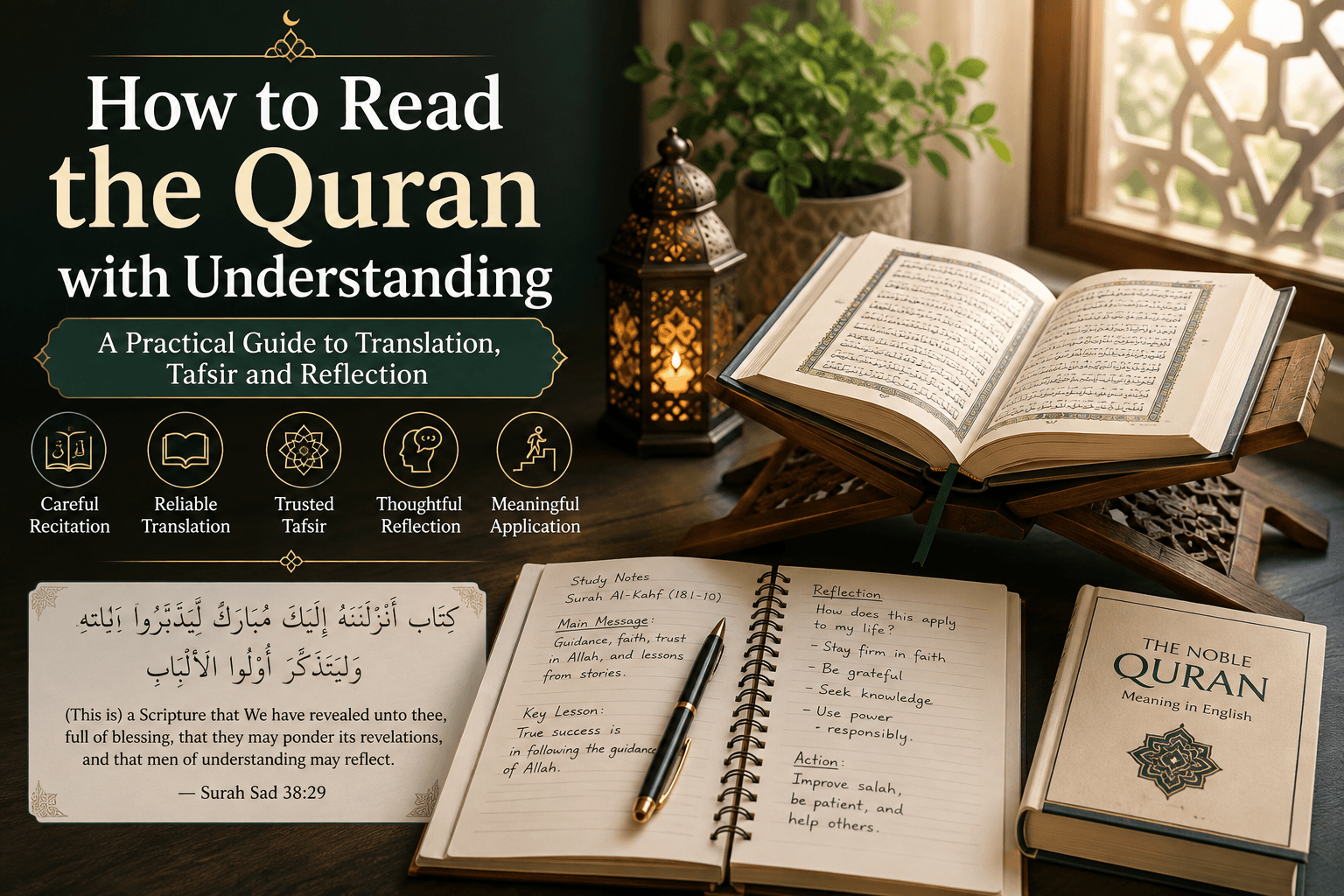
How to Read the Quran with Understanding
Learn how to read the Quran with understanding through careful recitation, reliable translations, trusted tafsir, thoughtful reflection, and practical application.
How to Start Reading the Quran: A Beginner’s Guide
Learn how to begin reading the Quran with a simple daily routine, careful recitation, a trusted translation, reflection, and guidance from a qualified teacher.
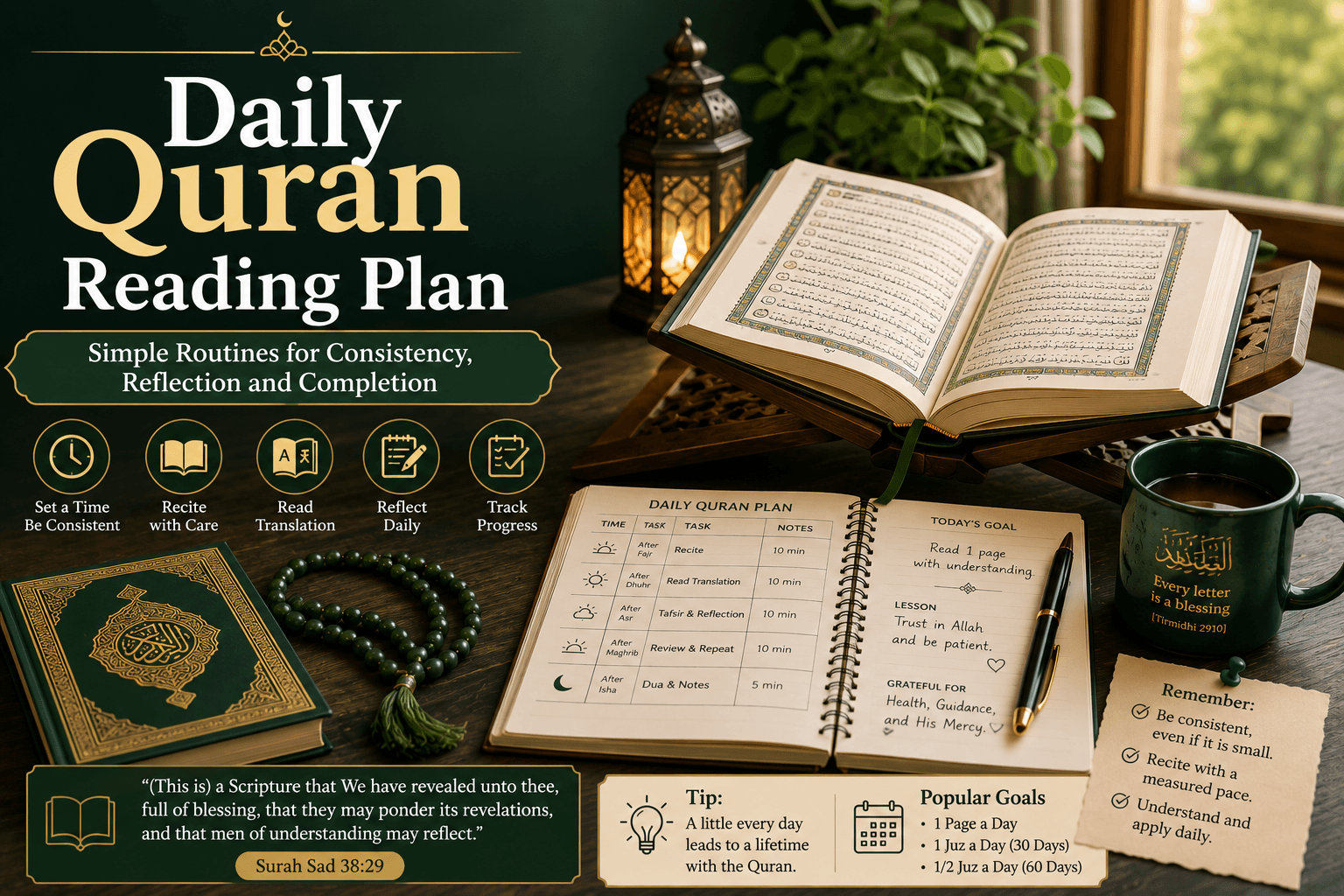
Daily Quran Reading Plan: Build a Consistent Routine
Create a realistic daily Quran reading plan with flexible 10, 20, and 30-minute routines, measured recitation, translation, reflection, and achievable completion goals.